
Series Note
Searching for the Missed Mystery of Life is a long-term body of work through which Abu Naser Robii investigates the invisible relationships connecting the human body, nature, consciousness, morality, and the cosmos.
Across drawing, printmaking, watercolour, acrylic painting, and performance, recurring forms such as roots, celestial bodies, serpents, seeds, plants, organs, and human figures construct a personal symbolic language. The series does not seek a single explanation of life. Instead, it opens a contemplative space where existence and non-existence, the physical and the spiritual, and individual and cosmic realities continuously intersect.
Artist’s Note
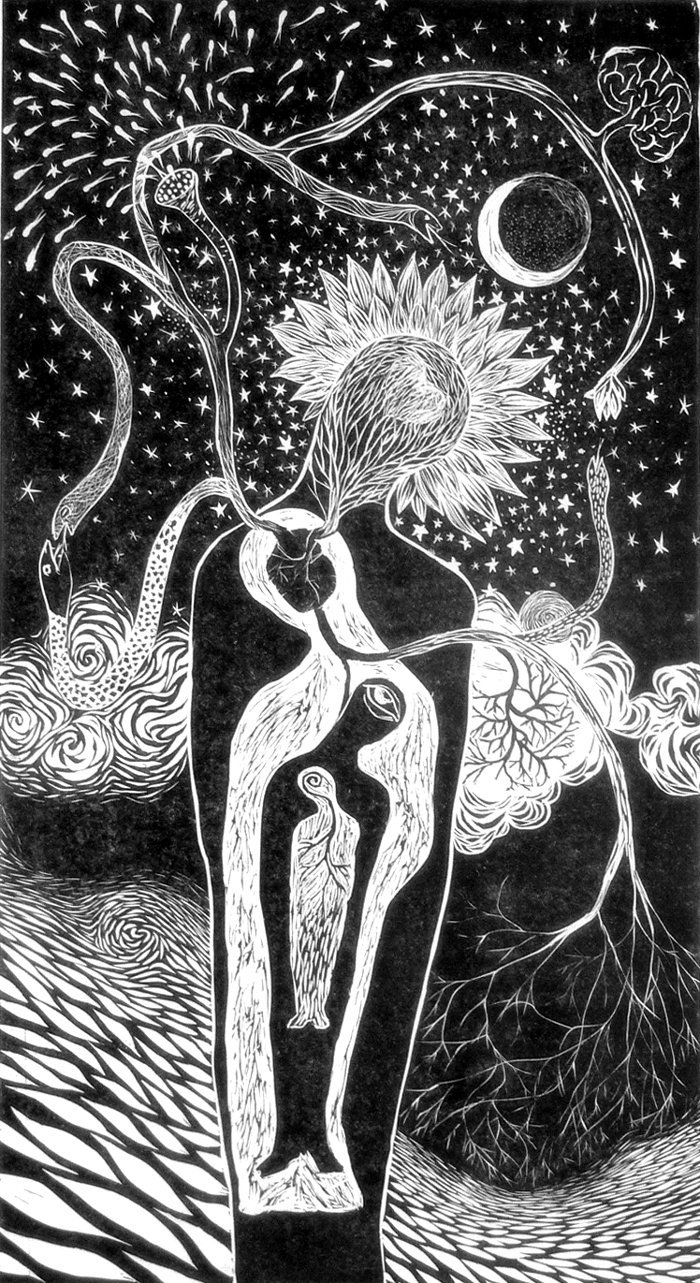
During this period, I was interested in imagining the human body as more than a physical structure. I saw it as a living field where memory, emotion, nature, morality, and cosmic experience could exist together.
The figure within the larger body represents an existence inside another existence. It may suggest memory, conscience, inherited experience, or a self that has not yet fully emerged.
The crescent moon, serpents, roots, brain-like form, and radiant head belong to a recurring symbolic language in my practice. These elements do not carry one fixed meaning. They allow different dimensions of life, transformation, instinct, thought, and cosmic rhythm to coexist within the same composition.
The process of linocut was equally important to me. Every incision permanently changed the printing surface. This physical act of cutting became a reflection on how experience leaves lasting marks on the human mind and body.
For me, the completed print is not separate from the process through which it was made. The carving, repetition, physical pressure, and gradual emergence of the image are all part of the work’s meaning.
Historical Context
This print belongs to Abu Naser Robii’s significant 2010 printmaking period. During the same phase, he created a monumental linocut measuring approximately 3.5 × 7 feet.
Two versions of that large-scale work received the Best Award in the Printmaking Category at the Biennale Young Artists Exhibition organised by Bangladesh Shilpakala Academy. One version of the award-winning work is currently held in the Grameenphone Head Office Collection in Bangladesh.
Although this print is an independent work, it belongs to the same period of technical experimentation and symbolic investigation.
Reviews
There are no reviews yet.